
Reducing climate impact
Everything starts with a Healthy Earth, because healthy potatoes grow in healthy soil. Every day, we work to produce safely and increasingly sustainably. Together with our partners across the value chain, we are building a fully circular process from potato to product, minimising water and energy use and preventing food waste and residual waste. Taking good care of our planet is essential – for todays and future generations.
At Aviko, we actively work to reduce our climate impact across the value chain. An important framework for this is the Science Based Targets initiative (SBTi). Together with our parent company Cosun, we have defined our ambition for structural CO₂ reduction towards 2030 and 2050. In 2025, our reduction targets were officially validated by SBTi. This validation confirms that our targets are aligned with the Paris Climate Agreement. It provides a solid foundation for accelerating the implementation of our sustainability plans, in close collaboration with our value chain partners.
Milestones in 2025
In 2025, our CO₂ reduction targets were officially validated by the Science Based Targets initiative (SBTi).
Through our Value Chain Agreement, with among others, customer Hutten, we realised the first reductions in the CO₂ emissions of our fries, from farm to fork. In total, the reduction potential approximately 75%.
Cosun and the Dutch government signed a tailor-made agreement enabling targeted investments and accelerating the sustainability transition of, among others, two Aviko production sites.
Together with 2BHonest, we strengthened our due diligence process, prioritising risks in the potato, transport, palm oil and dairy value chains.
Together with our transport partner AB Texel, we achieved a reduction in transport emissions using 15% biogas.
In 2025, we took further steps in responsible sourcing together with our suppliers, including during our Sustainable Suppliers Day and with the introduction of our Supplier Code of Conduct.
In 2025, the e-boiler at Aviko Rixona in Venray saved an average of 13% gas (equivalent to the annual consumption of 1,800 households), and a second e-boiler was commissioned in Warffum.
All Aviko activities in China now use green electricity. As a result, Aviko worldwide uses 100% renewable electricity.
A major step towards more sustainable production at Aviko in Lomm
In 2025, an important step towards more sustainable production was taken at our Dutch production site in Lomm. We started the construction and installation of a fully electric e-boiler. This e-boiler replaces part of the steam generation currently based on fossil fuels and runs entirely on green electricity. As a result, we achieve an annual CO₂ reduction of at least 4,800 tonnes.
Reusing water, making optimal use of the potato
At Aviko, we work every day to improve the circularity of our production processes. By reusing water as much as possible and making optimal use of the potato, we translate our sustainability ambitions into concrete actions in practice.
Accelerating sustainability together
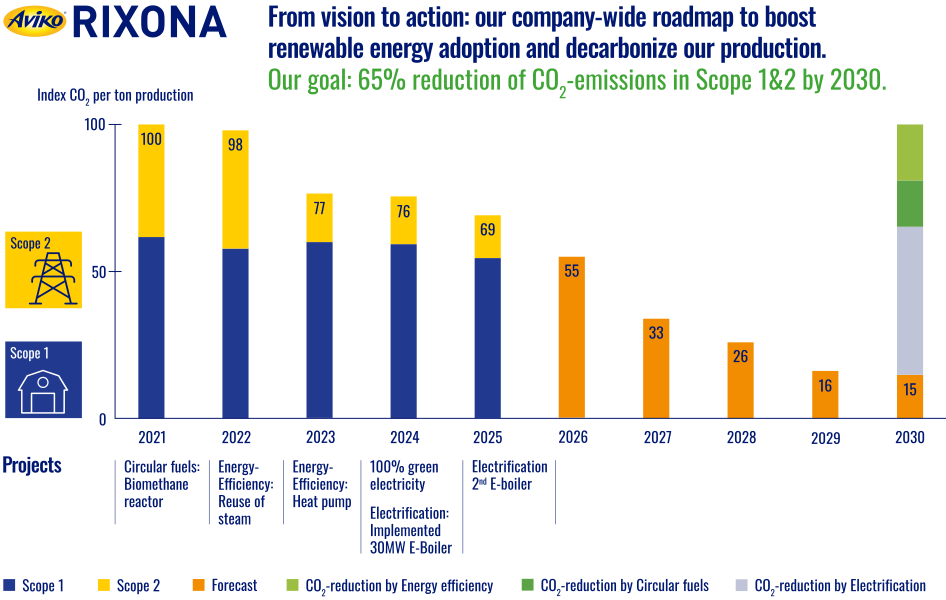
At Aviko Rixona, we are working step by step towards one clear goal: by 2030, we aim to have reduced our CO₂ emissions by 65 percent compared to 2021. We are not pursuing this through one major intervention, but by continuously identifying opportunities for improvement. Sometimes this requires major investments, sometimes smart adjustments to existing processes – and often a combination of both. Together with suppliers and distributors, we set up projects to accelerate sustainability throughout the value chain. At the same time, a comprehensive Scope 1 and 2 roadmap ensures that our production process becomes increasingly energy-efficient and sustainable. An important milestone within this approach is the commissioning of our new electric boiler in Warffum in 2025.
Engaging colleagues in smart improvements on the shop floor
Sustainability is not achieved through major investments alone. Just as important is the attention and awareness of colleagues in their day-to-day work. That is why, over the past year, we have focused on increasing sustainability knowledge within Aviko Rixona. Through the internal Sustainability School, we guide colleagues step by step through developments in sustainability. We explain why sustainability is a strategic pillar, how it contributes to our future resilience, and the role each department plays. In doing so, we strengthen both awareness and engagement within our teams.
Working together
Sustainability is a transition in which collaboration plays a key role. As part of Cosun, Aviko has additional leverage to accelerate this transition. We further strengthen this leverage through our Value Chain Agreement, working together with various value chain partners towards an emissionfree fries value chain.
Through our participation in Move to Minus 15, we are working with other industry partners to explore whether the storage and transport temperature of frozen products can be increased from –18 to –15 degrees Celsius. This change leads to lower CO₂ emissions, energy savings and reduced costs throughout the supply chain.
The energy transition also requires close cooperation with energy and technology partners. By flexibly aligning our energy use at our production sites, we actively contribute to relieving pressure on the electricity grid. In close collaboration with Sappi, we actively respond to periods of electricity scarcity and surplus, contributing tangibly to reducing grid congestion in the region.
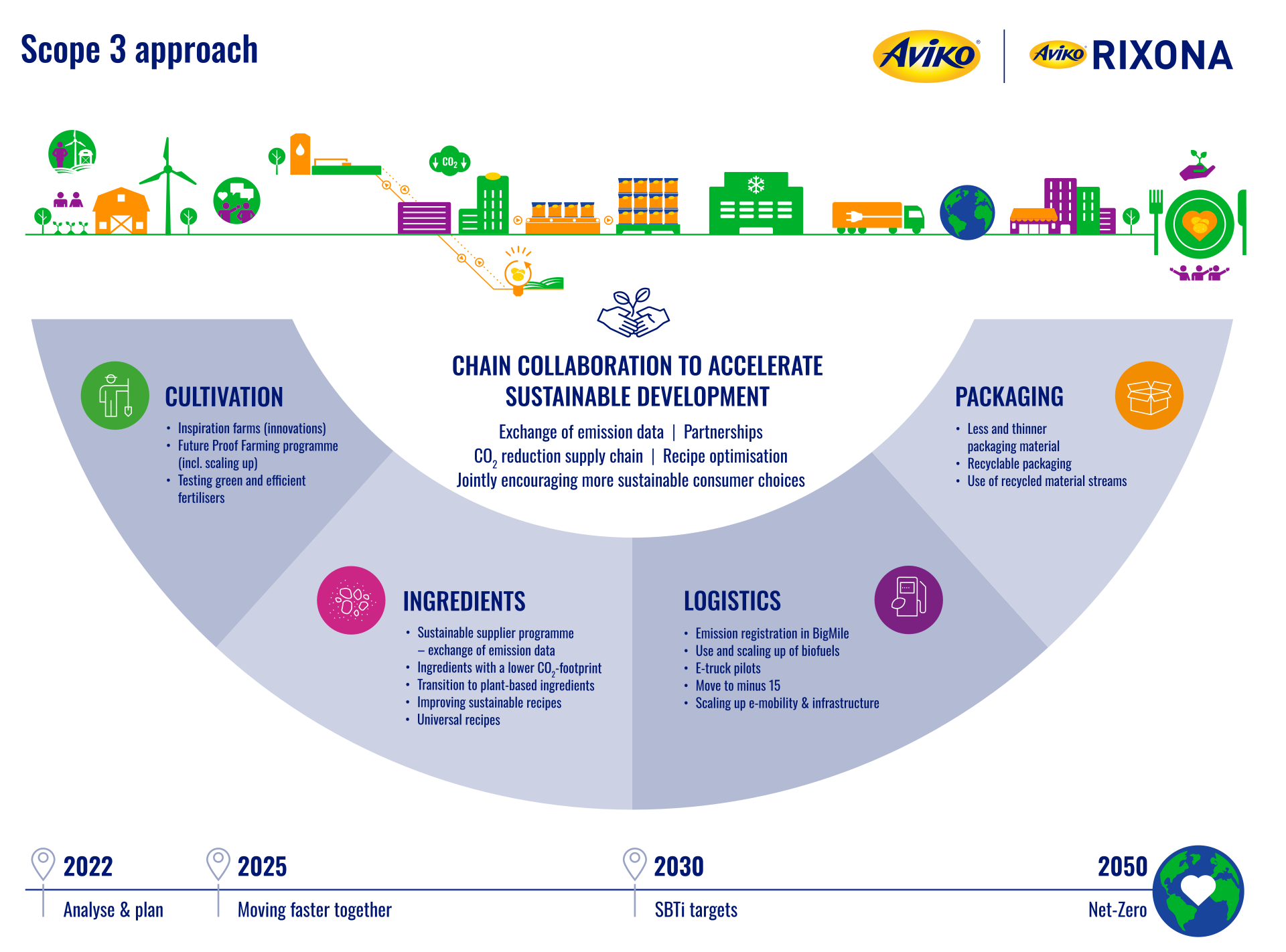
Most of Aviko’s climate impact lies in Scope 3: the emissions generated across our value chain. Over recent years, we have focused on measuring these emissions, prioritising hotspots, exploring and launching reduction projects, and establishing a coherent programme for governance and execution. Reducing emissions in the value chain is complex and takes time. Collaboration with growers, suppliers and customers is essential to achieve structural and scalable impact. Through various reduction pathways, we are working towards achieving our SBTi reduction targets for 2030.
Deforestation‑free sourcing chain
Within our broader climate ambition, we are committed to achieving a deforestation‑free sourcing chain. To reinforce this commitment, we have developed a sustainable procurement policy together with Cosun, including a Deforestation‑free Policy. This policy is aligned with the EU Deforestation Regulation (EUDR) and the Science Based Targets initiative (SBTi).
In 2025, we conducted an extensive due diligence assessment of our sourcing chains to identify, among other things, risks related to deforestation. The sourcing of palm oil for our Chinese production was identified as a remaining risk. For our European production, we have been sourcing deforestation‑free palm oil since 2023 through RSPO‑segregated certification, covering approximately 85% of the total volume.
For our Chinese production, we further explored options for sourcing deforestation‑free palm oil over the past year. This presents financial and logistical challenges, partly due to limited availability. In 2026, we will transition to RSPO mass balance palm oil in China, after which we will determine how to take the next step towards fully segregated sourcing.
Our goals and current status
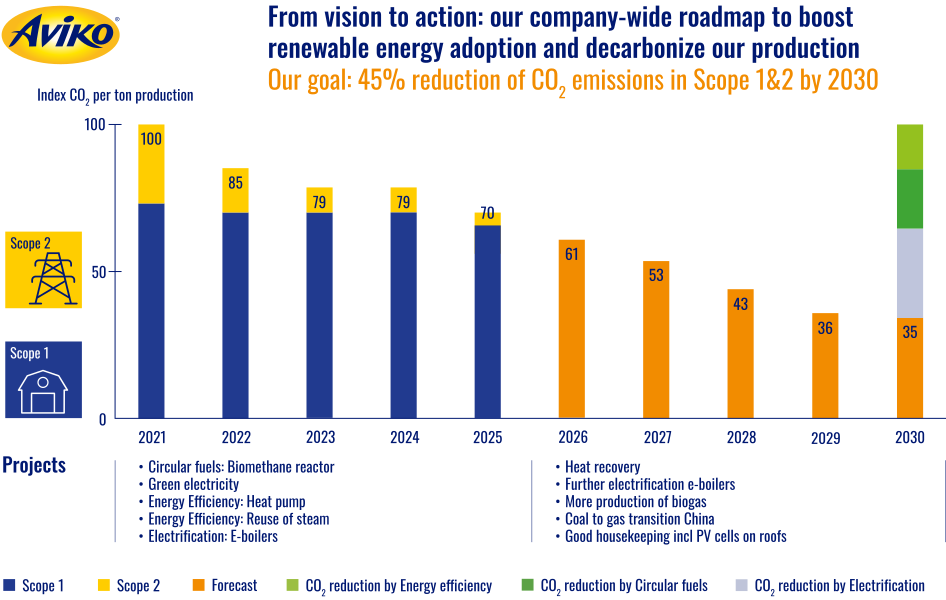
45% reduction in Scope 1 and 2 emissions compared to 2021
2025
-10%
2030
-45%
30% reduction in FLAG emissions compared to 2022
2025
*
2030
-30%
25% reduction in non-FLAG emissions compared to 2022
2025
*
2030
-25%
Net-zero CO2 emissions in scope 1, 2 and 3
2025
*
2050
0 Kton
100% green energy
2025
100%
2025
100%
Zero operational waste to landfill [ton}
2025
6.734
2025
0
100% recyclable packaging
2025
87%
2027
100%
50% reduction in food waste compared to 2022
2025
-12%
2030
-50%
30% reduction in water usage per ton of product compared to 2018
2025
+13%
2030
-30%

65% reduction in Scope 1 and 2 emissions compared to 2021
2025
-26%
2030
-65%
100% recyclable packaging
2025
75%
2030
100%
*At the time of publication, the figures for 2025 are not yet available.